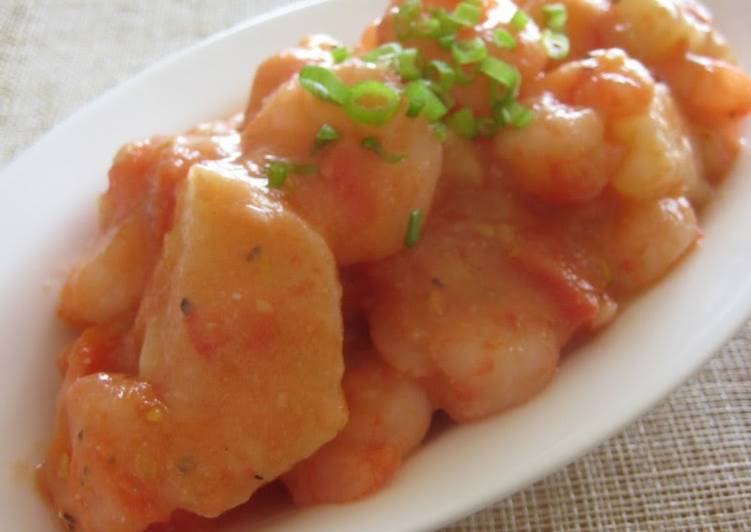
Hello everybody, it’s Louise, welcome to my recipe site. Today, we’re going to make a special dish, japanese-style simmered shrimp and nagaimo yam with tomatoes. It is one of my favorites food recipes. This time, I am going to make it a bit tasty. This will be really delicious.
Japanese-Style Simmered Shrimp and Nagaimo Yam with Tomatoes is one of the most well liked of current trending foods on earth. It is simple, it is quick, it tastes yummy. It’s appreciated by millions daily. Japanese-Style Simmered Shrimp and Nagaimo Yam with Tomatoes is something that I’ve loved my entire life. They’re fine and they look wonderful.
Nagaimo (Japanese mountain yam) salad, an elegant appetizer of raw crisp yam served with soy sauce and simple garnishes can be prepared There is some confusion between the two Japanese terms yamaimo and nagaimo, which are actually two distinct species of yam although the two names. Japanese yam, or nagaimo, is naturally sweet—and yes, the yam was the inspiration for the restaurant's name. Nibble on the top piece first, so you get the natural flavour of the yam "tofu".
To get started with this particular recipe, we have to prepare a few ingredients. You can cook japanese-style simmered shrimp and nagaimo yam with tomatoes using 11 ingredients and 7 steps. Here is how you can achieve that.
The ingredients needed to make Japanese-Style Simmered Shrimp and Nagaimo Yam with Tomatoes:
- Make ready 200 grams Peeled shrimp
- Make ready 250 grams peeled Nagaimo yam
- Get 1 Tomato
- Get 1 clove Garlic
- Take 2 tbsp Sake
- Get 1 tbsp Miso
- Prepare 1 Salt and pepper
- Prepare 1 Vegetable oil
- Get To prep the shrimp:
- Prepare 1 tbsp Sake
- Get 1 tbsp Katakuriko
Simmered shrimp cooked in dashi soy sauce and soaked overnight, this beautiful dish adds bright color and delicious flavors to Osechi Ryori. Shrimp with bright vermillion color brings beauty into the Japanese New Year feast, Osechi Ryori. Yamaimo/Nagaimo/Tororoimo is a type of yam that can be eaten raw and is used frequently in Japanese cooking. This confused me when I was a child because my grandmother always called it Tororoimo but my mom would mix it up and call it Nagaimo and Tororoimo.
Instructions to make Japanese-Style Simmered Shrimp and Nagaimo Yam with Tomatoes:
- Devein the peeled shrimp, if necessary. Rub in the prepping ingredients (sake and katakuriko), and rinse the shrimp.
- Peel the nagaimo yam, and cut into 1 cm slices (either whole or after cutting the yam in half lengthwise first).
- Chop the tomato coarsely. Finely mince the garlic.
- Heat oil in a frying pan. Add garlic and saute over medium heat until fragrant. Add the nagaimo yam and saute until it's starting to turn translucent - about 3 minutes.
- Add the peeled and cleaned shrimp and mix, then add the sake and tomato. Cover with a lid and simmer over low heat for about 5 minutes.
- Dissolve the miso. Taste, and add salt and pepper to taste, and turn off the heat.
- Transfer to a serving plate. Optionally, add chopped green onion (not listed) on top.
The Best Japanese Yam Recipes on Yummly How to cook Nagaimo? (Japanese Yam Recipes). Tofu Salad with Avocado and Mountain Yam Recipe. Nagaimo-no-buta bara maki (nagaimo Add the chopped green onions and sakura shrimp and mix well. Heat the salad oil in a skillet and pour in the mixture all at once.
So that is going to wrap this up with this special food japanese-style simmered shrimp and nagaimo yam with tomatoes recipe. Thanks so much for reading. I’m sure you will make this at home. There’s gonna be interesting food at home recipes coming up. Don’t forget to save this page in your browser, and share it to your loved ones, friends and colleague. Thank you for reading. Go on get cooking!